Welcome and Mabuhay

If you love Marinduque and want to contribute articles to this site, please do so. My contact information is in my profile. The above photo was taken from the balcony of The Chateau Du Mer Beach House, Boac, Marindque, Philippines. I love sunsets. How about you? Some of the photos and videos on this site, I do not own. However, I have no intention on infringing your copyrights. Thank you and Cheers!

Tres Reyes Island view of the Marinduque Mainland

Friday, July 15, 2016

The Lopez Memorial Museum and Library


During my search for interesting and relevant sites related to my Javellana-Lopez ancestral roots, I found several sites that were interesting and informative. The first three sites I have already posted in my blogs: Stevan Javellana's novel, Without Seeing the Dawn, Old Families of Jaro, Iloilo and their Mansions and my Ties with the Katigbak Surname during the Japanese-American War in the Philippines. This 4th site is the Lopez Memorial Museum and Library, located in Pasig, Rizal, Metro Manila. Here's a summary from Wikipedia for your information and reading pleasure:

"The Lopez Memorial Museum (LMM) was founded on 13 February 1960 by Eugenio Lopez, Sr in honor of his parents, Benito Lopez and Presentacion Hofileña. Eugenio Lopez built the museum to provide scholars and students access to his personal collection of rare Filipiniana books, manuscripts, maps, archaeological artifacts and fine art.

Eugenio Lopez is known to many as a leading industrialist of post-World War II Philippines. With resources that came from sugar production, he pioneered in diverse fields of business including transportation (bus, taxicab and air transport operations), mass media (ABS-CBN Broadcasting Corporation and The Manila Chronicle), energy (MERALCO) becoming one of the first Filipino successes in business in a then largely American dominated economy.

A staunch nationalist, Eugenio Lopez believed that by preserving and promoting the Filipino heritage, his country men would eventually develop sense of national pride and enable the country to develop a unified spirit ultimately resulting in ensuring a strengthening of a collective national soul in the succeeding generations.

He died in July 1975 in San Francisco, California, USA, where he had lived in self-imposed exile since 1972, away from the oppression of martial law. He had led a full life as a leading industrialist and a media magnate, leaving behind him a legacy for the Filipino people.

Eminent historian Renato Constantino was Lopez Museum’s first curator, from 1960 to 1972. Engaged by LMM founder and prominent antiquarian Eugenio Lopez, Sr (Eñing), it was only logical that it would be under his watch that the museum acquired Juan Luna’s España y Filipinas, a seminal work much cited for capturing the image of a country patronizingly led up the rungs of evolutionary colonial tutelage. Such acquisitions complemented the Philippine rare books and antiquarian map collection amassed by Eñing, who in consultation with renowned collector and connoisseur Alfonso Ongpin, further acquired other seminal and technically astute works by Luna, Felix Resurreccion Hidalgo, and Fernando Amorsolo. A second key acquisition phase was led by Eñing’s youngest son, Roberto Lopez who was inclined toward Philippine Modernism, thus improving this aspect of the LMM collection with works vetted under the supervision of art historian, Rod Paras Perez.

At present, the character of the Lopez Museum collection has cumulatively morphed with the institution’s shifting concerns. Today, one of the major challenges confronting LMM is the need to continually showcase segments of its permanent collection alongside contemporary Filipino creative expression couched within the frames of increasing inter-disciplinarity and merging communication platforms. It is in this light that curation brings the possibility of infusing context and sub-text to an otherwise private quest for personal roots and a shared locus for nationalist heritage.

The library collection consist with over 19,000 Filipiniana titles by about 12,000 authors, the Lopez Library houses an invaluable collection of Philippine incunabula, rare books, manuscripts, dictionaries, literary works in Western and vernacular languages, religious tracts, periodicals, newspapers, coffee table volumes, academic treatises, contemporary writing, maps, archival photographs, cartoons and microfilms. It remains a critical node in the small network of institutions devoted to ongoing Philippine scholarship produced locally and internationally.

Among its more important holdings are 21 rare titles of Philippine imprints dated from 1597 to 1800, 69 key titles from the 18th century, and 777 titles from the 19th century. The library’s rare books and manuscripts include those of eminent printers, Tomas Pinpin, Raymundo Magysa, Nicolas Bagay, Laureano Atlas, and Juan Correa. The library is home to the first edition of Belarmin-Lopez’s Doctrina Cristiana (Manila 1620) translated into Ilocano (Libro a naisuratan amin ti bagas), Pedro Chirino’s Relacion de las Islas Filipinas, as well as key editions of Antonio de Morga’s Sucesos de las Islas Filipinas (Jose Rizal’s 1890 edition, Blair and Robertson’s 1904 edition, and W. E. Retana’s 1909 edition).

In addition to a huge aggregate of secondary works on the National Hero, Dr Jose Rizal authored by both Filipino and Western authors, the Lopez Library also serves as steward to 93 of Rizal’s letters to his parents, sisters, brother and brothers-in-law, among other objects which constitute the most priceless items in LMM’s Rizaliana collection.

Among other items worthy of note are a variety of dictionaries, grammar books, and LMM’s collection of devotional literature: sermons, novenas, accounts of the lives of saints that were used as tools in the propagation of Roman Catholicism during the Spanish colonial period. Equally important and indispensable are such primary sources as the manuscripts and personal papers of individuals such as Pablo Pastells, Gaspar de San Agustín, Eulogio Despujol, H. L. Legarda, Manuel Sastron y Piñol, and Justo Zaragosa.

Microfilm copies of the Philippine Revolutionary papers, commonly known as the Philippine Insurgent Records, American Consular Reports (1817–1898) from the National Archives, Washington, DC, USA. and several reels of the British Consular Reports, circa 1844–1898, together with the H. H. Bartlett collection from the American Philosophical Society Library, Philadelphia, Pennsylvania, USA, are among the significant additions to the library’s growing microfilm collection which also includes the Tribune (1925–1945), Manila Chronicle (1945–1972), Harpers Weekly, and other key periodicals which are already accessible through digitized versions ".

This place is on my bucket list of things to visit, the next time I will be in the Philippines.

Saturday, July 9, 2016

My Ties with the Katigbak Surname

Segunda Solis Katigbak

One of the events I listed of my childhood years during The Japanese-American War in the Philippines that baffled me still until today was the instruction of my Dad, that if a stranger asked us our family name, we should never, never tell the truth, and that we are the Katigbaks not the Katagues.

My Dad who was in the guerilla forces was afraid that our surname could be a target for annihilation by the Japanese forces if we ever got caught in our hide outs in the foot hills of Iloilo in Panay Island. There were rumors that the Japanese were able to get a list of guerillas of Panay and that the collaborators ( Filipino spies) are helping the Japanese kill all families that are in that list. Two events about the Japanese atrocities that I had knowledge of are listed in the notes below.

So for a while, from 1942 to 1944 I had inculcated in my mind that I am a Katigbak not a Katague. I would repeat several times the surname, so if the times comes when we are captured by the Japanese forces, I will not make the mistake of giving our real name. I have asked myself several times all these years why my Dad chose the Katigbak surname. Was it because it start with the letter "K"? Or was he related to the Katigbak clan of Iloilo? Or did he just pick up the name at random? For these reasons, I did some Internet search on the Katigbak clan and here's three excerpts I found interesting. For details visit: https://lipatourism.wordpress.com/culture/lipasoldgentry/

1. Segunda Solis Katigbak was Jose Rizal’s first love interest and probably the best known of her clan. While studying at Colegio de la Concordia in Santa Ana, her brother, Mariano brought her with him in a party where she met Jose. Smitten, Rizal showered the fourteen-year-old lass with flowers, poems, and sketches. Unfortunately this romance was short lived because when she turned sixteen she went back to Lipa and married her uncle, Manuel Metra Luz, a wealthy planter. It was said that one time he visited Lipa to solicit funds for La Liga Filipina. Rizal met Manuel Luz and played chess with him and when he lost, he said, “I not only lost the game, but my heart, as well.”

2. The earliest known recorded ancestors of the Katigbak clan were Don Juan Catigbac and Doña Nicolasa Concepcion. Their son, Tomas Catigbac, married Juana Masongsong. Their union produced ten children: Maria, Rita, Eustaquia, Pasqual, Agustin, Juliana, Magdalena, Micaela, Josef, and Felipe.

Pasqual M. Catigbac married twice. His son (from the second wife, Andrea Manguiat), Exequiel Manguiat Catigbac, married Aniceta delos Reyes, daughter of the famous Lipa gobernadorcillo, Don Gallo delos Reyes. (Don Gallo spearheaded the widespread cultivation of coffee in the town.)

The son Bernardino delos Reyes Catigbac, a teniente primero, married Rosela Metra Mayo. Their son Gregorio Mayo Katigbak, a revolucionario and a well known politician. He became Batangas’ delegate during the First Philippine Legislature in 1907-1909. With his strong desire to provide education to the youth, he led the establishment of the Instituto Rizal in 1899 which produced Lipa’s great men of caliber. Later on, his son, Dr. Jose Maria Braceros Katigbak (Presidente Municipal 1945-1946), carried on his father’s mission and thus founded “The Mabini Academy” of Lipa.

Josef M. Catigbac became gobernadorcillo in 1827. He married Andrea Aguila Calao. They had seven children: Maria (married to Alejandro Altamirano) Cayetano, Norberto, Lino, Francisco, Mateo (Married to Petra Mendoza then to Dominga Gonzales), and Susana (married to Manuel Mayo).

Mateo Catigbac became Lipa gobernadorcillo in 1858.

Cayetano became gobernadorcillo in 1865. He married Fausta Tapia who owned large tracts of undeveloped land, which were all cultivated by the time she died. They had four children: Torribio, Leoncia, Petra, and Maria. When Don Cayetano remarried, the children transferred their mother’s properties to their names.

Torribio (Presidente Municipal, 1901-1902), said to be the richest person in town during the coffee boom, married Salvadora Solis y Metra. Of all their children, only Macaria Solis Catigbac had heirs. She married Perfecto Salas of Molo, Iloilo, a law partner of Rafael Palma. They had two sons and one daughter, Adela Catigbac Salas (now Adela Salas Gatlin). Adela’s mother and brothers horrifically died during the Second World War. Their estate was divided between her and a nephew. She was so rich that from just the proceeds of molasses – by-product of the sugar harvest – she could travel around the world annually. Don Toribio’s descendants are the only remaining family who use the hispanized “Catigbac ” instead of the spelled Letter K which is now presently used by the “Katigbak” family. This was due to his instruction never to Filipinize their surname and all his heirs should be proud of their Spanish heritage.

3. Valeriano Katigbak Luz worked for the Philippine Bureau of Commerce. He was married to Rosario Mayo Dimayuga, also from Lipa, the doyenne of Philippine Interior Designers who after her death was conferred several awards, the most distinguished being, the Lifetime Achievement for Interior Design. Valeriano’s children were: Vicenta, Alfredo, Remedios, and Arturo.

Eldest daughter, Vicenta Luz, married Carlos Cosculluela of Negros. Their son, Rafael, became Negros Occidental Governor in 1998. Alfredo Luz, an architect trained under Frank Lloyd Wright in the U.S.A and a good friend of J. D. Rockefeller, designed: the regional World Health Organization (WHO) building, the Magsaysay Center, and the Los Baños International Rice Research Institute (IRRI) complex – all Rockefeller Philanthropic projects in the country. He married Carmen Montinola of Bacolod. Another daughter, Remedios, married Teodoro Baluyot of Pampanga. Youngest, Arturo Rogerio Luz, was declared National Artist for Visual Arts in 1979.

Here's the link of the Katigbak surname to the Lopez surnames of Iloilo:


4. Maria Kalaw Katigbak was endowed with both beauty and brains. She was certainly the crème of the crop in the springtime of her youth. Born to a noble breed, she showed her humble nature even during her moments of success. In the beginning, her beauty went unnoticed, but fate must really have its own plan for her to become a future beauty queen. As a student at the university of the Philippines, she became the muse of the U.P. College of Law’s Bachelor Club and then a regimental sponsor twice.

In 1931, she eventually decided to up her career by joining the Manila Carnival beauty pageant. Held from 1908-1939, the Manila Carnival was a goodwill event to celebrate the harmonious U.S.-Philippine relations; where the two countries showcase their commercial, industrial and agricultural progress. The highlight of this event was the crowning of the Manila Carnival Queen.

Maria’s mother was the first Queen of the Orient of the Manila Carnival. It was most likely that she too became a beauty pageant competitor. Whether it was in her blood or not did not matter for Maria was her own woman. The queenship of the 1931 Manila Carnival was left contested by her and Alicia de Santos, a mestiza beauty from an affluent family. During that time the deciding factor in a beauty contest lay with the contestant with the highest number of sponsors. At first, Alicia being wealthier, had the upperhand. Maria on the other hand had her father’s mason friends who helped a lot in augmenting her votes. It became a neck-to-neck contest which lasted for 8 weeks. At the end Maria came out triumphant with an insurmountable lead of 1 million votes over her formidable contender. She was then crowned as Miss Philippines of 1931. Not a soul knew then that Maria Kalaw would become the future “original sweetheart” of the Philippine Senate. But the beauty queen turned senator was more than meets the eye for she was also intellectually gifted. Coincidentally her beauty is well-deserved for she was born on the date when beauty and heart are united, this day is known as “Valentine’s Day”.

Maria Kalaw-Katigbak was born on February 14, 1912 in Manila. She is the eldest among the four children of Teodoro M. Kalaw, writer, statesman, former secretary of the Interior, and director of the National Library, and Pura Villanueva, a Spanish mestiza of the prominent Lopez – Villanueva family of Jaro, Iloilo, also a writer, pioneer for women’s suffrage and property rights for women, and first president and organizer of the League of Women Voters.

Notes: Two events of the Japanese atrocities that personally affected me were:

1. The slaughter of the Noel Balleza clan of Barotac Viejo, Iloilo. The family were relatives of my mother. Their hideouts were not far from where we were hiding during the war.

2. The slaughter of my aunt's family, Adela Catague Guillergan of Binalbagan, Negros Occidental. I just learned of this incident when I was doing research on my ancestry on my father side of the family. Adela is my father youngest sister.

Wednesday, July 6, 2016

The Old Families of Jaro, Iloilo and Silay, Negros Occidental

The old Jaro Cathedral-only a few minutes walk from my Parents residence on Arguelles Street, 1934-1941

During my Internet search relating my to article on my great, great grand parents Don Manuel Javellana and Dona Gertrudis Lopez of Jaro, Iloilo, I found the following three sites interesting reads. I have completely identified with the pictures and articles in these 3 sites. It reminded me of my childhood years. If you love history, these three sites are worth your time, especially if you are an Illongo or have ancestral roots in Iloilo.

1. https://remembranceofthingsawry.wordpress.com/2010/06/01/the-families-of-old-jaro-iloilo/

Here is one interesting excerpts from readers comments in the above site:

"Jaro, they said, was the town then known as populated by residents whose surnames can all be pronounced phonetically as “he,he, he”. Those surnames which began with the letter “J” were first allocated to those living around the Jaro Plaza. Those which started with letter “H” to those who lived across the Jaro River (and towards now Leganes township. Those which started with letter “G” to those who lived south of Ungka creek (now part of Pavia township). To the West was the township of Mandurriao, and they were allocated the letter “M’. Now La Paz district of Iloilo City was intermittently a barrio of Jaro or a separate township and they were allocated the letter “L”. Through time the surnames began mixing through the different areas of Jaro. Iloilo City proper was given the letter “Y” but later evolved as just “I”. The letter “V” was also Iloilo City. Arevalo was letter “A”. Molo was a “miscolansa” as it was the “Parian” or the designated Chinatown, hence there was no fixed first letter, just whatever Chinese surname that was common. Also, if you visit the old churches, you would see “lapidas” of the dead dating as far back as 1860. You would also find many of the surnames mentioned in this blog in those lapidas ".

After reading entries from the above site #1, I concluded that the Javellanas and Lopezes were two of most affluent and influential families from Jaro at that time. Other influential families were the Ledesmas, Hechanovas, Hofilenas, Montinolas and the Jalandonis.

2. http://www.silayheritage.com/2011/10/graciano-lopez-jaena-and-eustaquio.html
Excerpts from the above site:

"Graciano Lopez-Jaena went to live in Negros to escape the fury of the Spanish authorities in Iloilo after he wrote Fray Botod. It was never officially published, but a copy was widely circulated in the region to the ire of the friars, fortunately for Lopez they could never prove that he wrote it. However because he was openly defiant against authorities and fought for justice, he got threats to his life. He decided to leave Iloilo and stayed with relatives in Silay and Saravia. With the help of his cousin Estaquio, Graciano Lopez fled to Barcelona Spain after staying in Silay for two years. While in Spain it was said that Eustaquio sent him regular financial support. Eventually, Graciano feared that his relatives in Negros will be persecuted so, he added 'Jaena' to his surname to separate himself from the them and thereby sparing his family from suspicion. His family through his uncle in Saravia in gratitude for his help, gave Eustaquio a wooden Santo Niño which has since become a family heirloom and has been passed on to my family in 1981. What is ironic is that we only confirmed this as fact more than a hundred years later, when we were able to connect with Graciano Lopez Jaena's descendants - those of his brothers' families. You see, Eustaquio Lopez is my great-great grandfather".

3. http://www.valcaulin.com/article/iloilos-old-houses-and-mansions/1479/comment-page-1/#comment-194629
The Lizares Mansion
Excerpts from the above site:

" Iloilo is known for its Dinagyang Festival, La Paz Batchoy, colonial churches and old houses. And when we speak of this city’s old houses, they are are not just your typical ancestral houses or bahay na bato. This city is home to many mansions built by sugar barons way back in pre-war era. Some are still standing with some old people or caretakers residing while some are now used as schools.

If you are traveling or visiting the City of Love, bring your camera and wear your most comfortable shoes and discover these old houses and mansions in Iloilo. There are many of them in the city and what I have here are just a few of them. I am featuring those famous old houses and mansions but it is easy to spot many old abodes as you explore Iloilo. If you don’t know where to start, just go to the main plazas in the city – Jaro, Molo and Libertad. In accordance to the Spanish status quo, those living close to the plaza are the most affluent ones. So aside from taking shots or visiting old churches, you can also check out these ancestral and heritage houses of Iloilo.

Those located around Jaro Plaza are the grandest and there are still plenty of them. Still, you can see many old houses in Molo and even Arevalo. For this post, majority of these houses are located around the district of Jaro ".

Note: The Lizares mansion and the Nelly Gardens were my two of my most favorite mansions when I was a child in Jaro, Iloilo. My childhood dream of seeing the inside of the house had never been realized, but now I am happy just reading it in the above blog. Thank you for the tour, Valerie!

Saturday, July 2, 2016

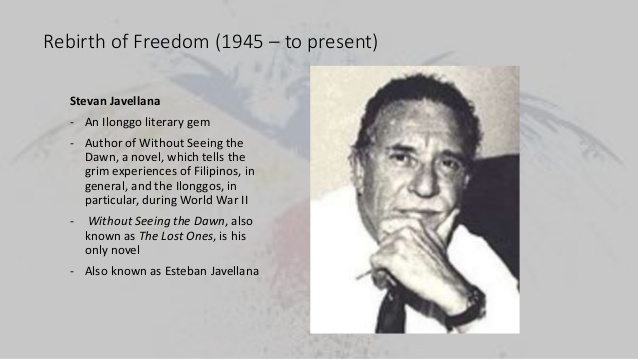
Stevan Javellana-Without Seeing the Dawn


In my last posting I discussed that my great, great grandparents were Don Manuel Javellana and Dona Gertrudis Lopez from Jaro, Iloilo. In that article I mentioned that one well-known Lopez was Fernando, formerly Vice President of the Philippines for three presidential periods in Philippines history, but did not mentioned any famous Javellanas from the Philippines. This posting is listing one famous Javellana both well known in the US as well as in the Philippines

During my search for famous and accomplished "Javellanas", I discovered a novel written by Stevan or Esteban Javellana at a time period and locale identical to my childhood and teenagers years- Without Seeing the Dawn. I have not read the book, but based on the summary below, I will put reading this book and watching the Movie ( Santiago), number 1 priority in my bucket list. Here's some information about the book and its author from the Internet.

Stevan Javellana (1918-1977) was a Filipino novelist and short-story writer in the English language. He was also known as Esteban Javellana. He was born in San Mateo, Rizal, Philippines, twenty-two years after the execution of the Philippine paladin, José Rizal in 1896. He fought as a guerrilla during the Japanese people|Japanese invasion of the Philippines. Javellana stayed in the U.S. after World War II in 1945, but died in the Visayas( Iloilo) in 1977 at the age of 59.

Without Seeing the Dawn was published by Little, Brown and Company in Boston in 1947. Esteban other short stories were published in the Manila Times Magazine in the 1950s, among which are Two Tickets to Manila, The Sin of Father Anselmo, Sleeping Tablets, The Fifth Man, The Tree of Peace and Transition.

Without Seeing the Dawn is his only novel. The title of Stevan Javellana's only novel in English Without Seeing the Dawn was derived from one of José Rizal's character in the Spanish-language novel Noli Me Tangere or Touch Me Not.

Javellana's 368-paged book has two parts, namely Day and Night. The first part, Day, narrates the story of a pre-war barrio and its people in the Panay Island particularly in Iloilo. The second part, Night, begins with the start of World War II in both the U.S. and the Philippines, and retells the story of the resistance movement against the occupying Japanese military forces of the barrio people first seen in Day. It narrates the people's "grim experiences" during the war. This war experiences remind me of the articles, I have written on my childhood experiences during the American-Japanese War in the Philippines in Panay Island published in my HubPages Account and in my blogs and autobiography(http://hubpages.com/literature/my-childhood-memories-of-world-war-2).

Javellana's novel was first published in 1947 and sold 125,000 copies in the U.S. and was reprinted in paperback edition in Manila by Alemar's-Phoenix in 1976. The same novel was made into a film by the famous Filipino film maker and director, Lino Brocka under the title Santiago!, which starred the Filipino actor and later presidential candidate, Fernando Poe, Jr. and the Filipino actress, Hilda Koronel.

It was also made into a mini-series film for Philippine television. The published novel received praises from the New York Times, New York Sun and Chicago Sun. Without Seeing the Dawn, the novel, became the culmination of Javellana's short-story writing career. The said novel was also known under the title The Lost Ones. It is currently a book requirement of the Grade 7 students of the University of the Philippines Requirement High School.

Personal Note: I wanted to buy the book on line or through Amazon. The cheapest used copy was listed for $61.94 and the most expensive was listed for $294.00. This is just too expensive for my budget. Instead I am reading a review of this novel in this website: Enjoy! http://www.academia.edu/2612039/ON_STEVEN_JAVELLANAS_NOVEL_WITHOUT_SEEING_THE_DAWN

Thursday, June 30, 2016

Presenting Carenna KT Latest Original Song-His Revenge


Once again, I am very, very proud presenting my 13-year old grand daughter Carenna Katague Thompson (KT) latest original song. You are getting better and better every day. Is this your number 7 original song? Keep up with the good work. Your proud LOLO and LOLA.

Tuesday, June 28, 2016

Don Manuel Javellana and Dona Gertrudis Lopez were my Great, Great Grand Parents

The David Jamili K(Catague) Family, Barotac Viejo, Iloilo, 1955

I have enjoyed tracing my roots down to my great, great Grand Parents, Don Manuel Javellana and Dona Gertrudis Lopez. Most of the information of my ancestral roots I have read from the blog, www.javellana.wordpress.com. Most of the information in the blog regarding my ancestry were confirmed by several living relatives in the Philippines about two years ago. Other detailed information about my roots were verbally communicated to me by my father during my childhood years in Barotac Viejo, Iloilo, Philippines.

I am so proud that in my veins are the blood and genes of the Javellanas and Lopezes from Jaro, Iloilo, Philippines. In this post, I am also discussing the origin of the Javellana and Lopez surnames.

Hello Readers:
My name is David Balleza K(C)atague, Jr. I was born in Jaro, Iloilo, Philippines on December 20, 1934. My Father was David Jamili K(Catague) and my mother was Paz Barrido Balleza.

My Father's father ( my grand father) was Roberto Catague( married to Consolacion Golez Jamili). Roberto was the oldest son of Marcelina Javellana who was married to Victoriano Catague. Roberto died when my father was still young. His mother remarried Ruperto, the younger brother of Roberto. Consolacion and Ruperto had eleven other children.

My father had two other brothers, Guillermo and Julio. The three brothers changed the spelling of their last name from Catague to Katague when my father was still in elementary school. My father was raised and sent to dental school by his rich aunt from Leganes, Iloilo. His reason was that he wanted his surname to be in the middle of the alphabet, because he does not want to be called early in class by a demanding teacher, who asked questions by alphabetical order. Strange reason but I believe this was true.

Marcelina Lopez Javellana was the youngest daughter of Don Manuel Javellana and Dona Gertrudis Lopez. Marcelina was also the youngest sister of Don Cristino Javellana, known as Capitan Tinong who was very active in the political and religious life and activities during his time( 1890's) in Jaro, Iloilo, Philippines ( www.javellana.wordpress.com)

Cristino Javellana was the sixth of the nine children of Don Manuel Javellana and Doña Gertrudis Lopez. His other siblings besides Marcelina were Escolastica (married to Geronimo Jiz de Ortega), Petra (married to Sixto Golez), Quintana (born 1840), Narcisa (born 1842, married to Simon Grecia), Inocencia (born 1849, married to Juancho Jamora), Mariano (born 1851, married to Crispina Gamboa), Florentina, Cristeta, and Carmen (married to Miguel Jayme y Lopez).

The origin of the surname Javellana according to Wikipedia is:

Javellana
is a family surname from the Philippines(1850s) who originated from Jaro, Iloilo City in the Visayas. The original name of the Family was "Kim Byong" and is of Chinese descent. Due to a mandate by the Spanish Government, ordered by Spanish Governor General D. Narciso Claveria (November 21, 1849) for the natives of the Philippines to adapt the Spanish naming system, they and a number of Chinese and Filipino families were forced to adapt new names.

The name they chose was derived from Avellana, the Common Hazel (Corylus avellana), which was further derived from the town of Avelino in Italy. The appended letter "J" to the name was in deference to their hometown, Jaro.


Corylus avellana, commonly called European filbert, European hazel or cobnut, is a deciduous, thicket-forming, multi-trunked, suckering shrub that typically grows to 12-20’ tall. It is native to Europe, western Asia and northern Africa where it is typically found growing in rich thickets, woodland borders, wooded slopes, hedgerows, clearings and along streams.
Javellana Coat of Arms
On the other hand, the name Lopez is indeed a surname of Spanish origin.
Lopez Coat of Arms
The Lopez surname was originally a patronymic, meaning "Son of Lope", Lope itself being a Spanish given name deriving from Latin lupus, meaning "wolf". The surname is first attested in Old Castile in the heart of Spain, where the name originated in Visigothic times; however, the name is not of Germanic origin. Its Portuguese equivalent is Lopes, its Italian equivalent is Lupo, its French equivalent is Loup (or Leu), its Romanian equivalent is Lupu or Lupescu and its Valencian equivalent is Llopis. López is the most common Spanish surname in the United Kingdom as well as in the Philippines.

The most well known Lopez in the Philippines was Fernando. He married another Javellana ( Mariquit). I remember my father mentioned when I was a teenager that both Fernando and his wife Mariquit were our relatives. For those of you who have not heard of Fernando Lopez ( I was a recipient of the Fernando Lopez scholarship during my sophomore year at University of the Philippines Iloilo in 1952-1953), here's his short biography from Wikipedia.

Fernando Hofileña Lopez, Sr.,a Filipino statesman was born on April 13, 1904 and died on May 26, 1993. He was a member of the influential Lopez Family of Iloilo. Fernando Lopez served as Vice President of the Philippines for three terms – under Elpidio Quirino (1949–1953) for the Liberals and Ferdinand Marcos (1965–1969 and 1969–1972) for the Nacionalistas and also the chairman of ABS-CBN Corporation from 1986 to his death 1993.

Lopez was born in Iloilo City, Iloilo. His parents were Benito Lopez and Presentacion Hofileña. He was the younger brother of Eugenio Lopez, Sr. The Lopez family was very influential and the richest family in the province.

Lopez studied high school at San Juan de Letran College, finishing in 1921. He then studied law in the University of Santo Tomas, earning his Bachelor of Laws degree in 1925. After passing the bar examinations, he did not go into private practice, but helped his older brother manage the family business.

In 1945, with no prior political experience, Lopez was picked by President Sergio Osmeña to be mayor of Iloilo City. In 1947, he ran for Senator and won the election.

Lopez was one of the founders of University of Iloilo and the FEATI University in Manila. He is a descendant of Graciano Lopez-Jaena of Iloilo. And who is Graciano Lopez-Jaena? Here's some information from Wikipedia.

Graciano López Jaena was born on December 18, 1856 and died on January 20, 1896. He was a journalist, orator, revolutionary, and national hero from Iloilo, Philippines, who is well known for his newspaper, La Solidaridad.

Philippine historians regard López Jaena, along with Marcelo H. del Pilar and José Rizal, as the triumvirate of Filipino propagandists. Of these three illustrados, López Jaena was the first to arrive in Spain and may have begun the Propaganda Movement, which was a movement based in Spain that advocated the reform of the then-Spanish colony of the Philippines and which eventually led to the armed Philippine Revolution that begun in Manila in 1896. The Propaganda Movement was a key step towards a Philippine national identity.

Note: I am dedicating this article to my six grand children: Ian Katague King, Elaine Katague King, Philip Winchester Katague, Alix Katague, Marina Katague and Carenna Katague Thompson. Remember the saying that if you know your past you will have a clear direction to see your future.

Sunday, June 26, 2016

Time for Some Cool Bandurria Music and Philippine Folk Dances

It had been 3 digits temperature here in Northern California the last couple of days. No cooling off is expected in the next 4 days. So, It is time for some cool bandurria music and some Pinoy Folk dances.
Philippine National Folk Dance

Have you heard of bandurria? The bandurria is a plucked chordophone from Spain, similar to the mandolin, primarily used in Spanish folk music, but also found in countries that were once colonies of Spain.

Prior to the 18th century, the bandurria had a round back, similar or related to the mandore. It had become a flat-backed instrument by the 18th century, with five double courses of strings, tuned in fourths. The original bandurrias of the Medieval period had three strings. During the Renaissance they gained a fourth string. During the Baroque period the bandurria had 10 strings.

The modern bandurria has 12 strings (6 pairs). The strings are tuned in unison pairs, going up in fourths from the low G#. The lowest four strings are a major-third above those of a standard guitar and the highest two strings are a fourth above a standard guitar, i.e. G♯, c♯, f♯, b, e and a( From Wikipedia).

Here's a collection of Philippine Folk Dance music with the Bandurria ( Rondalla) music with Amorsolo's Paintings in the background. Enjoy!

Friday, June 24, 2016

Zion David Katague is Now Two Months Old

Zion David Katague-2 Months Old. Zion is the grand son of my brother, Dolce Ruben Balleza Katague from Bacolod City, Negros Occidental, Philippines. Read the following blog on the five living David Katague's on Planet Earth.
http://marinduqueawaitsyou.blogspot.com/2016/04/the-5th-living-david-katague-zion-on.html

Wednesday, June 22, 2016

My Five Favorite National Parks

Hawaii Volcanoes National Park

Last Monday was officially the start of the Summer Season here in Northern California. The temperature is near 3 digits as expected the last couple of days and my air conditioner is continuously humming. Yesterday, The First family were in the news visiting Yosemite National Park-one of my favorite park. These two events reminded me of an article I wrote in 2009 about the US National Parks that Macrine and I had visited since 1960.

Macrine and I have visited several parks in the US but the following five national parks are our favorite.


1. ARCHES: The park is known for its natural arches. There are more than 2000 ranging in size from a three foot opening up to the Landscape Arch which measures 306 feet from base to base. It lies near the heart of the desert called the Colorado Plateau, in the State of Utah. Towering spires, fins and balanced rocks complement the arches, creating a remarkable assortment of land forms in a small area. You can bike, hike or drive an 18 mile scenic road from the entrance to the north point of the Park. There are three picnic areas along the way. The two most famous arch are the Delicate and Skyline Arches.


2. BRYCE CANYON: The park is famous for its unique geology, consisting of a series of horseshoe-shaped amphitheaters carved from the eastern edge of the Paunsaugunt Plateau of Southern Utah. The erosional force of frost-wedging and the dissolving power of rainwater have shaped the colorful limestone into bizarre shapes including slot canyons, windows, fins and spires called “Hoodoos”.
The park was named after the Mormon pioneer Ebenezer Bryce and it become a national park in 1924.

My wife and I visited this park just after my retirement from FDA in 2002. This visit was one of the best vacation we had since my retirement. Tinted with colors ranging from light brown to dark red, these whimsically arranged rocks, creates a wondrous landscape of mazes. A 45 minute walk from Inspiration to Sunset Point was the highlight of our visit. Ponderosa pines, high elevation meadows, and fir-spruce forest border the rim of the canyon and abound with wild life. Several scenic points offer a panoramic view of three states and about 200 miles of visibility. We did not stay overnight, but our guide tour and driver, informed us that the lack of large light sources nearby, creates unparalleled opportunities for for stargazing at night.


3. GRAND CANYON: This park is the only natural wonder of the US, that made it to the final 28 natural Wonders of the world as announced by the new 7 natural wonders of the world organization.
Macrine and I have visited this park and we agree with the 7 new natural wonder judges that Grand Canyon should be one of the top 28 finalists in this worldwide contest. I am even hoping that it will be voted one of the 7 new natural wonder of the world.

The Grand Canyon is more than a great chasm carved over million of years ago through the rocks of the Colorado Plateau. It is more than an awe-inspiring view. It is more than a pleasuring ground for those who explore its roads, hike its trails or float in the currents of the turbulent Colorado River.

The Canyon is a gift of nature that transcends what we experience in life. Its beauty and size humbles us. Its timelessness provokes a comparison to our short existence in this universe. Visiting the place makes me feel calmed and relaxed , as I gazed in amazement the beauty and splendor of this National Park. The park can be enjoyed whole year round.


4. YOSEMITE: Macrine and I have visited this park a number of times about two decades ago, when my family was still residing in the Stanislaus County, Modesto, California. The park embraces a spectacular tract of mountain and valley scenery of the Sierra Nevada. It was made into a national park in 1890. The park has a number of waterfalls, meadows, forests that include groves of giant sequoias, the world largest living trees.

The park highlights include the Yosemite valley, high cliffs, and waterfalls. There is the historic Wawona Hotel( famous for its Christmas Dinners and Decorations), the Mariposa Grove, which contains hundreds of giant sequoias, Glacier Point, Tuolumne Meadows and a large sub-alpine meadow surrounded by mountain peaks and Hetch-Hetchy- a reservoir in a valley considered a twin of Yosemite Valley. Ninety Five percent of the park area is designated as wilderness areas that provides opportunities for solitude and relaxation. There are over 800 miles of trails for hiking and backpacking. There is some trout fishing in the streams that my family enjoyed during one of our visits several years ago. Our first visit to the park in the early 1970's was my first experience in camping. One night, our camp site and garbage can was visited by the bears - an experience my kids will never forget. The visit of the bears was the highlight of our trip to Yosemite at that time. The classic beauty and fascinating ecosystems of the Sierra Nevada Mountain range are well represented in the wilderness of Yomesite National Park. I consider this park very friendly to families with small children.


5. ZION NATIONAL PARK: This is another park that my wife and I just visited after my retirement. The park is home to narrow canyons, overlooks, emerald pools, a petrified forest, a desert swamp, springs and waterfalls, hanging gardens, wild flowers and wildlife .It is located in Southwest Utah near the Arizona border. Zion is part of the Southwest “ Grand Circle” of national parks, monuments, historical areas and recreation areas. It is also a wilderness preserve which includes the world largest arch-KOLOB ARCH, spanning 310 feet. The park has high plateaus, a maze of narrow, deep, sandstones canyons and striking rock towers and mesas. The North Fork of the Virgin River has carved a spectacular gorge with canyon walls that rises to 2000-3000 feet above the canyon floor in most places. My wife and I just spent just 90 minutes touring the canyon by the Park's bus. We did not have the time to hike or at least stay overnight. We wish we have more time to enjoy the wild life flora and fauna of the park. According to the park's guides, the Park is home to many mammals and critters such as the collared lizard, Gambel's quail and sometimes even a golden eagle.

Other parks that we have visited are as follows: The Redwood National Park, the Muir Woods National Monument, The Point Reyes National Seashore, The Sequoia and Kings Canyon National Park, The Hawaiian Volcano National Park (photo above), Shenandoah Mountains, and the Blue Ridge Mountain and its famous Skyline Drive in Virginia, and the Luray Caverns in West Virginia. For description of these parks, visit the National Park Service site at www.nps.gov/parks.

Sunday, June 19, 2016

Food for Thoughts on Father's Day Today

This year all my four children(The 4 D's) did not forget me today. My oldest son sent me a Fathers' day Card three days ago and will probably call me later this evening for his annual greetings. My other two daughters are here now preparing lunch. My oldest daughter arrived at 10:30AM bringing Italian Pasta and Green Salad. My youngest daughter and grand daughter arrived shortly with appetizers and my favorite dessert-Cheese Cake.

My youngest son who lives with us and helped me take care of his Mom enhanced/fixed my computer ( faster with more memory and-Windows 10) charging me only $250 for the parts. His labor for fours hours was free and told me it is his Fathers Day Gift to me. My oldest daughter also gave me a Red Lobster gift card, I can use any time. Thanks to all of You my 4 D's. To my oldest son, Happy Fathers Day to you also.

I am attaching a video ( Daddy Day Trio)for your enjoyment. Two other videos that I loved in this set are Katherine McPhee and Chris Mann's duet of the Prayer and the Three Tenors of Pavarotti, Domingo and Carreras singing "I Did it My Way" with Frank Sinatra in the audience.


Fathers' Day reminds me of the responsibility of Parenthood. I found the following quotes timeless and applicable to all Fathers and Mothers of Today and of the future.

1. Marriage is an institution, but who wants to live in an institution.

2. The trouble with most average American is that they expect their children to be above average.

3. The best inheritance a parent can give his children is a few minutes of his time each day.

4. A mother of 13 children was asked "how in the world can you have time for 13 children" she replied, "when I had only one child, it took all my time, what more can 13 do?

5. A Chicago psychologist lists these rules for parents to insure their child happiness
Avoid favoritism, do not compare one child to another
Don't be too dominating; don't impose your own ambitions or hobbies
Don't be upset at what your neighbor's children accomplish
Don't remind yourself constantly that you worked harder or had fewer privileges.

6. The fear of depriving our children has produced the most "gifted" generation of children in our history. We shower them with gifts to prove our love, with the inevitable result that the gift of love has degenerated into a love of gifts. Are we offering things as parent substitutes? Are we offering presents instead of our presence? Are we giving things because we are reluctant to give time or self or our heart?

Related Posts Plugin for WordPress, Blogger...

LinkWithin

Related Posts with Thumbnails
Related Posts Plugin for WordPress, Blogger...